


- Silver detection
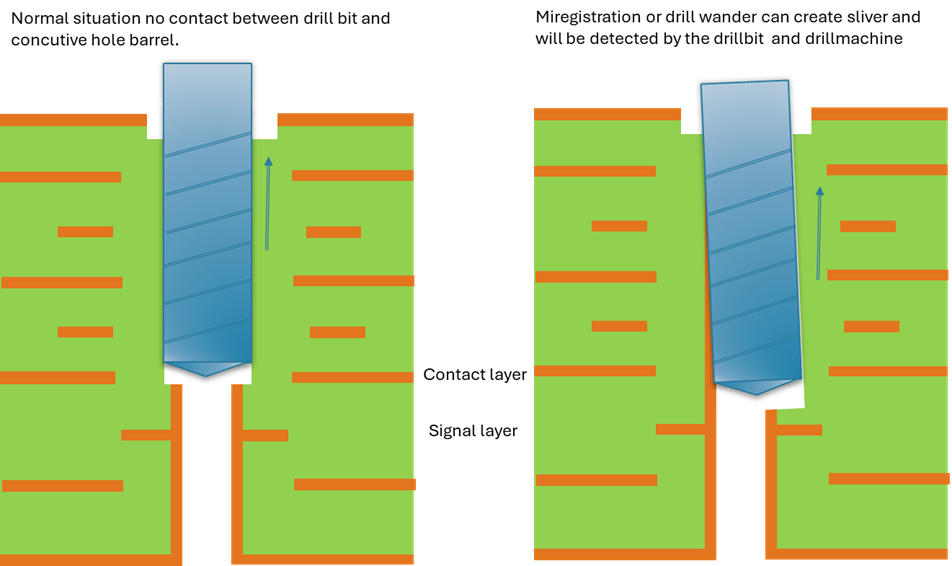
In the case of misalignment a sliver can be formed that directly influences the performance of the circuit.
By retracting the bit and performing a measurement an open circuit should be found. In the case a short is measured this point to a sliver on the hole wall or loose sliver.
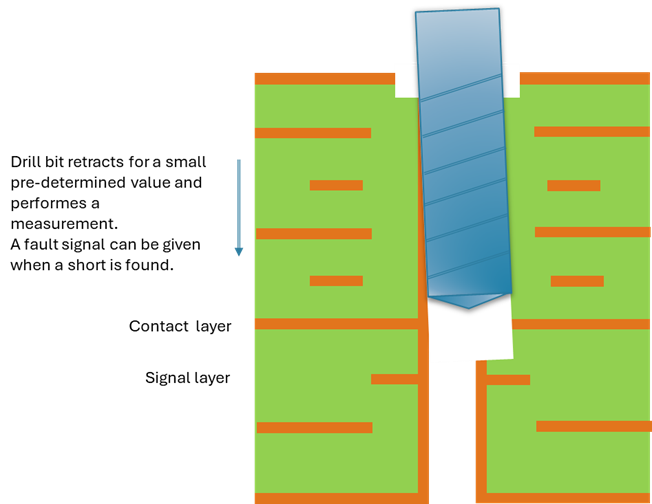
2. The third technique of sliver detection is to measure if there is a short between the conductive hole barrel and the drill bit when retracting the bit without the use of a contact layer.
Conclusion
The layer sensing and / or sliver sensing have specific advantages and disadvantages as listed below.
The advantages:
- No operator set-up on drill depth, design determines depth.
- No dependency on thickness tolerances in the board/dielectrics
- Smaller variation in stub length between back drilled vias
- Smaller stub length
- Sliver detection
The disadvantage:
- We have a power / GND layer exposed in the back drill section of the hole close (0,2-0,3mm depending set-up) for Method #1.
- Preparing the surface, removing the copper surrounding the backdrill hole. This is done on the drill machine with an oversized bit (in respect to the backdrilling diameter) or etching the opening.
- Remove copper around hole on top
This area (on top) is not used as there will be no contacts to this position on the backdrilled side of the hole.
The removal process is using contact drilling as well.

- Forward with the backdrill diameter and stop above MC layer.
Set the drill depth up to remove the hole barrel above the Must Cut layer. This is a rough set-up but as close to the must cut layer. At this stage the drill bit is making contact with the outside copper over the plating.

- Layer sensing
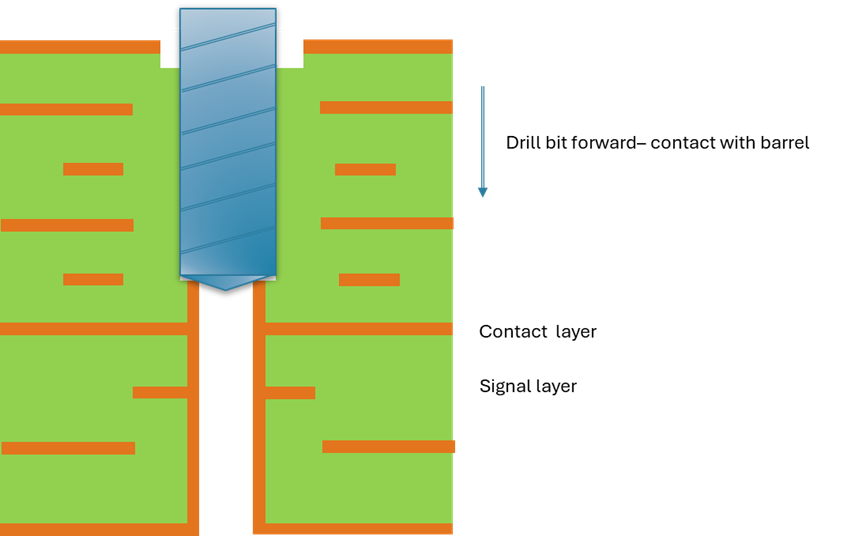
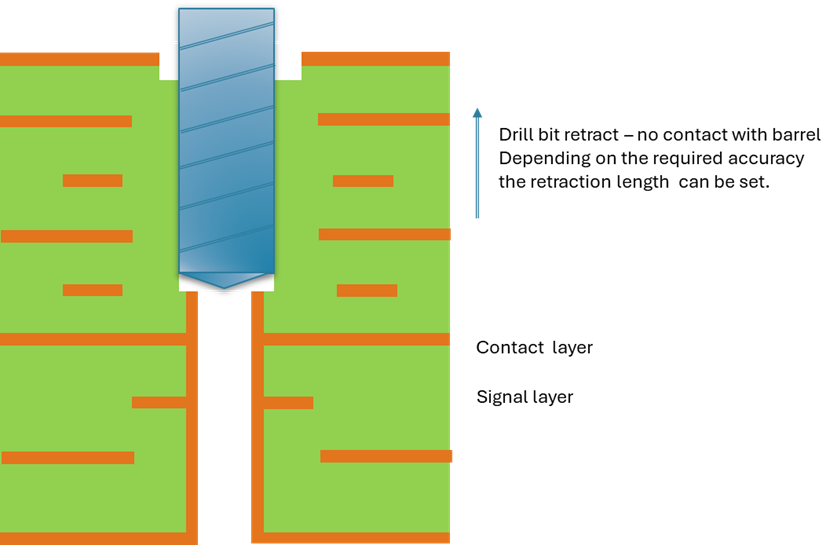
We want to find the layer by moving the drill bit up and down and measure if there is still contact with the barrel or if the contact is with the contact layer.
This up and down movement in combination with the sensing needs to be programmed in the drill machine. The increments of forward and retraction distance determine the accuracy of determining the position of the contact layer.

- Layer sensing – contact with barrel/ circuit closed
- Layer sensing – contact with barrel/ circuit open
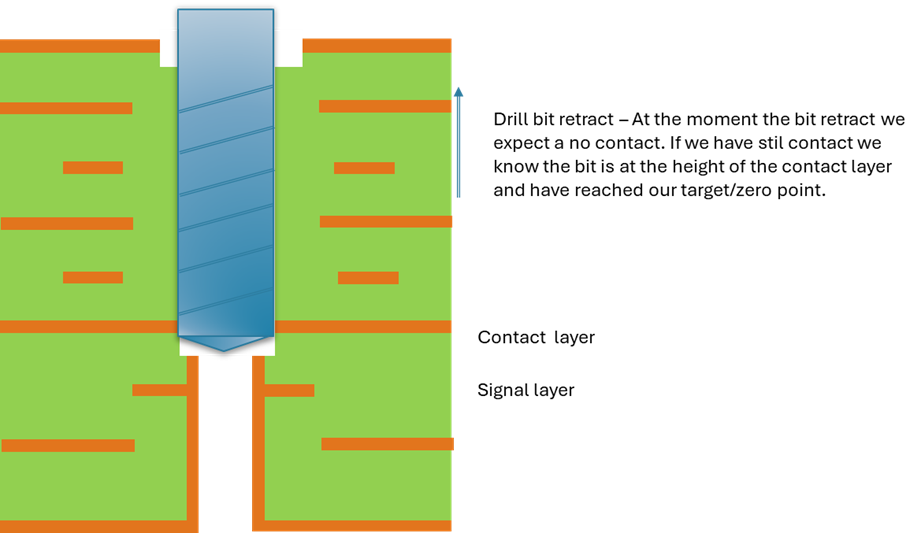
- Layer sensing – contact with barrel/ circuit closed
- Remove stub
The drill bit can now remove the smaller remainder of the barrel close to the signal layer. The tolerances in the dielectrics are smaller and therefore the distance to the signal layer can be set smaller as the risk of cutting the signal layer is smaller.
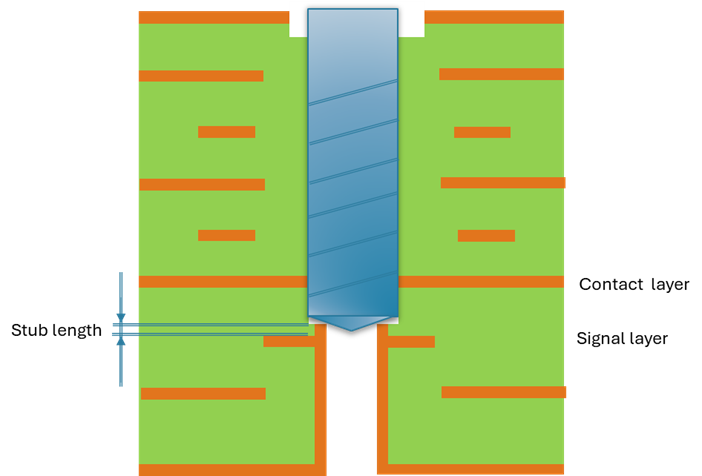
Recommendation distance Contact to Signal layer
The depth of the contact layer can be positioned in principle at a distance to the signal layer that:
- Enables a large enough distance between contact layer that forms a large enough electrical isolation.
- Forms a large enough barrier that is large enough not to form a CAF /EM failure. A minimum distance for CAF (drill to metal is typical in the range of 0,2 – 0,225mm)
- The contact layer should not to be too far away in the case a sliver is formed it can be detected using the methods described in the document.
- Create a safety margin to the signal layer to the back drilled section that is in the region of minimum 0,1mm (stub length).
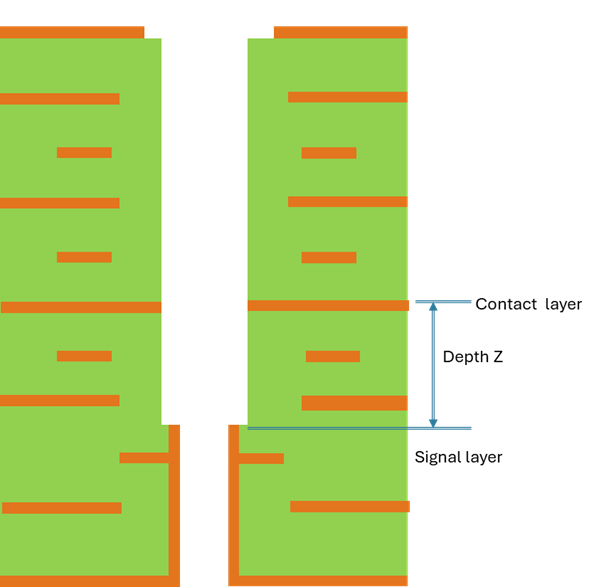
The contact layer does not need to be directly above the signal layer. The contact layer is a reference to zero the drill machine depth and eliminate the dielectric thickness variation.
At the moment the drill machine is set to zero (z-axis) the depth the drill bit can commence the set depth Z.
The extra space enables a good CAF barrier and is close enough to the signal layer.
The dielectric spacing between Contact and Signal layer in the example is for most high speed products about 0,3mm. The depth setting Z could be 0,2mm yielding a stub of 0,1mm.
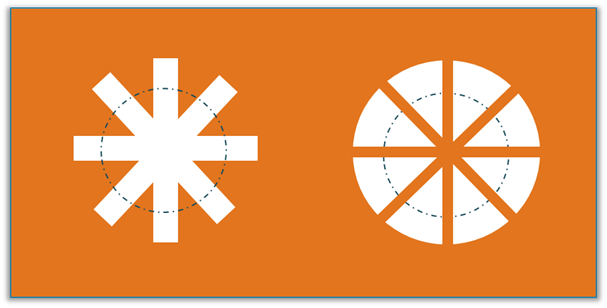
Shape of contact layer
The drill bit can now remove the smaller remainder of the barrel close to the signal layer. The tolerances in the dielectrics are smaller and therefore the distance to the signal layer can be set smaller as the risk of cutting the signal layer is smaller.